

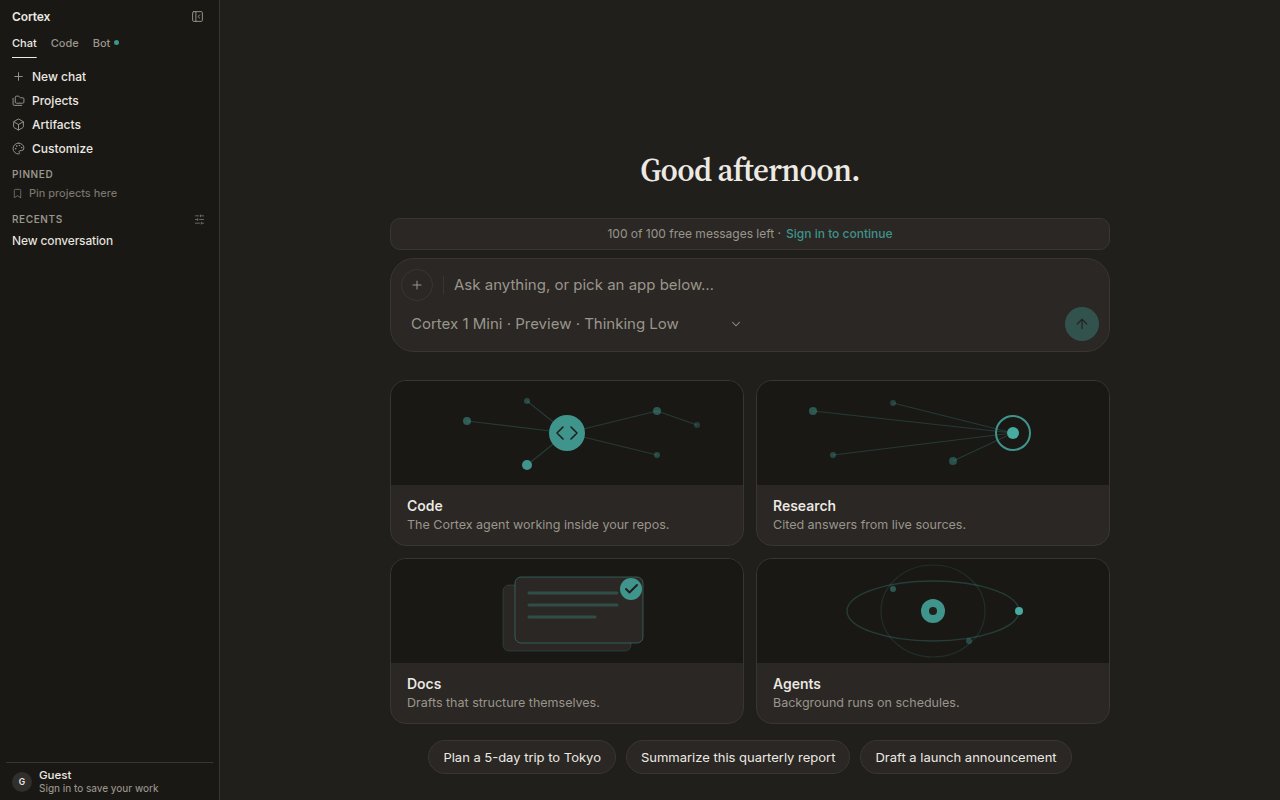
Chat home in the dark theme — the composer with its model chip and the four starting points: Code, Research, Docs, Agents. Theme is under Settings → General.
Start here

Quickstart
First message, attach a file, pick a model, keep the thread in a project.
Projects
Standing instructions, chats, and files kept together.
Tools and connectors
Built-in tools, connected apps, GitHub, and MCP servers.
Finding your way around
The sidebar holds everything Chat can open. Three of its entries are worth knowing before you start clicking.
New chat is an action, not a selected row. Pinned collects the projects you use most.
The composer
- + opens Attach file, Image, and Check origin.
- The model chip — for example Cortex 1 Mini · Preview · Thinking Low — switches model, sets the Thinking level, and toggles Deep Research.
- Enter sends, Shift + Enter adds a line, Esc stops a response.
- While a turn runs the placeholder reads Cortex is responding… and the send button becomes a stop control.
The four cards on Chat home
They are shortcuts, not separate products.A thread
Every reply carries Copy, Listen (when voice is available), and thumbs up or down. The thread header offers Start a plan and Move to project. Replies render markdown — headings, tables, and syntax-highlighted code blocks with their own Copy button.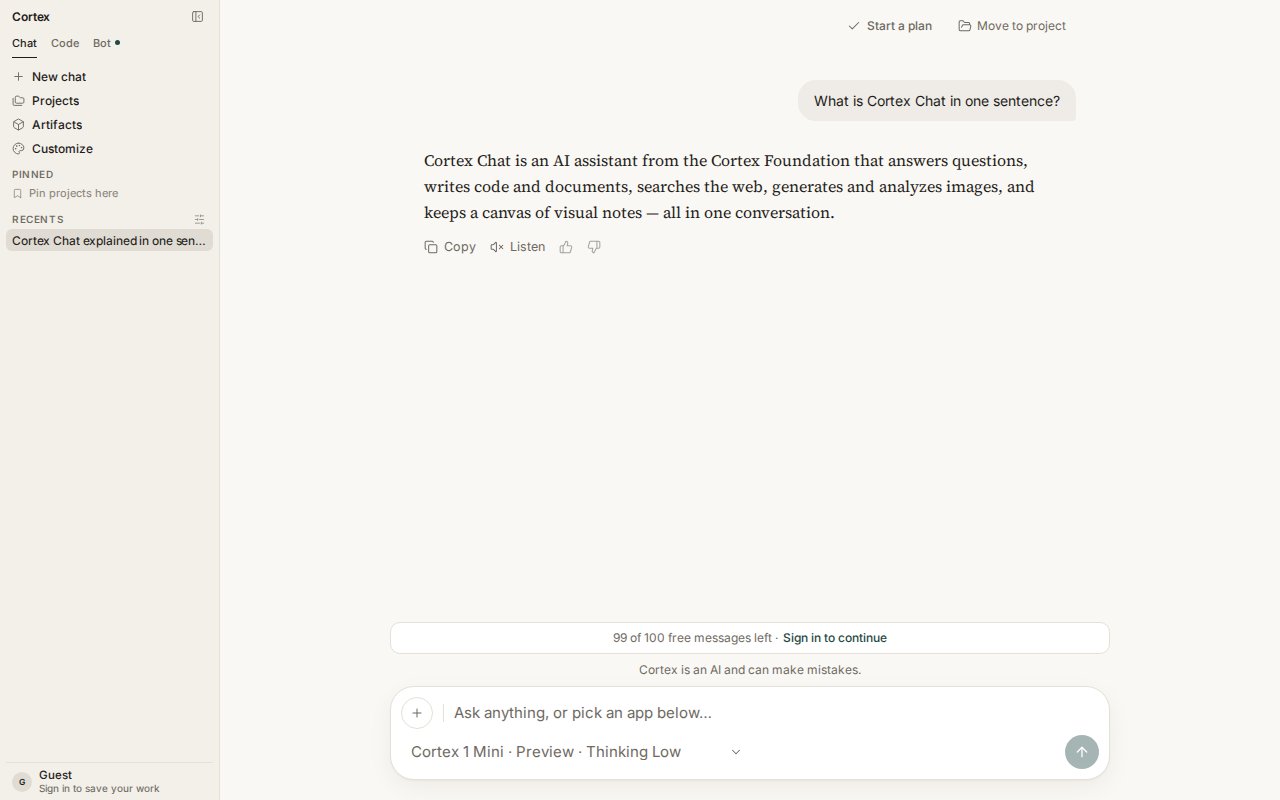
A Chat thread. The reply carries Copy, Listen, and feedback controls; the header offers Start a plan and Move to project.
Core guides
Projects
Standing instructions, chats, and files kept together. Every chat in a project starts from its instructions.
Library
Everything you uploaded and everything the assistant produced. Files stay when a chat is deleted.
Plans
Turn a long answer into steps you can tick off. Start one from any chat or from Planning.
Models and thinking
Cortex 1 Mini, Cortex Teutonic-1, the Thinking level, and what happens at peak hours.
Tools and connectors
Built-in tools, connected apps, GitHub, and MCP servers — and which product each connection reaches.
Sharing and teams
Chat is per account. What that means for projects, plans, and threads.
Research and media
Deep Research
Plan the questions, read live sources, write a cited report.
Image generation
Cortex-Image-1 from the composer. Quota, not a paywall, on Free and Guest.
Origin check
Ask whether attached media is authentic. Fails closed when it cannot run.
Voice
Dictate with the mic and hear answers with Listen — when the deployment supports them.
Context that carries over
Memory
Standing preferences and facts, reviewable and deletable one by one.
Canvases
A document sidecar beside the conversation, drafted by Cortex or by you.
When to switch
Chat does not run Code’s workspace shell or Bot’s computer. Chat’s Python tool is a snippet sandbox with no workspace, and it cannot see a repository.Under the hood
- How Chat works — the tool loop, compaction, and Chat’s round budget.
- Streaming — tokens, then tools, then the finished reply; what happens on a dropped connection.
- Settings — theme, language, shortcuts, defaults, privacy.
- Chat troubleshooting — messages that are not errors, and what to do next.
Next
- Chat quickstart — from an open tab to a useful first conversation.
- Projects — instructions your chats start from.
- Models and thinking — pick a model per conversation.
- Tools and connectors — connect an app or an MCP server.